
Carmen Lau




| Picture | Part Number | Manufacturer | Stock | Action |
|---|---|---|---|---|
 | XC95144XL-10TQG100I | Xilinx | 9,610 |
No. AMD's XCN23009 v1.1 lists June 29, 2024 as the final-order date, subject to material availability, and December 28, 2024 as the final-delivery date. Both precede this September 23, 2026 review. Its scope includes every speed and temperature grade of XC95144XL-TQG100. A present-day inquiry concerns existing material and its suitability for service; the notice does not establish a seller's current stock or the terms of a new transaction.
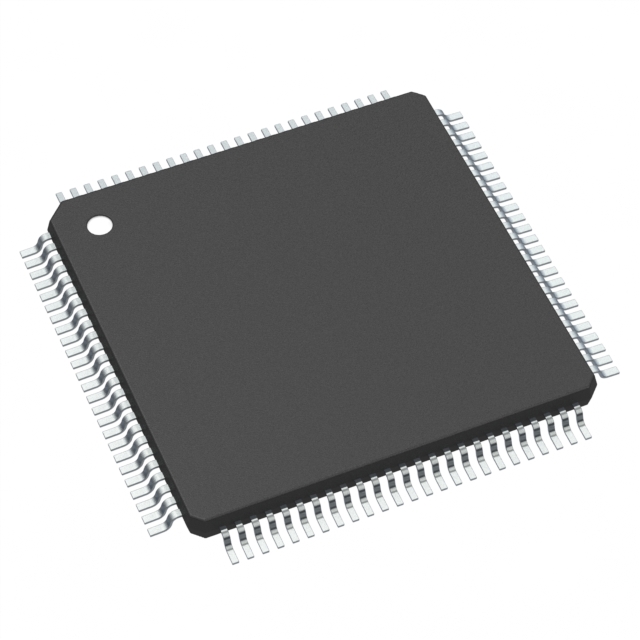
XC95144XL-10TQG100I identifies the 144-macrocell device with the -10 speed grade, a lead-free 100-pin TQFP package and industrial ambient operation from -40°C to +85°C. That package exposes 81 user I/O. DS056 specifies 10.0 ns maximum I/O-to-output delay for the -10 grade; the family's 5 ns headline does not apply to this suffix. Keep the complete code on the purchase and acceptance records rather than shortening it to XC95144XL.
No. DS056 separately warns that programming is specified at 0°C to +70°C ambient. The industrial operating range of -40°C to +85°C does not extend that programming range. A service procedure should define the programming conditions and the subsequent operating tests separately. This is especially relevant when a board normally operates in an unconditioned environment but is programmed or reworked at a service facility.
Article: W38-19
By: Carmen Lau
Manufacturer: AMD-Xilinx
A replacement CPLD is only useful if it can become a working replacement on your board. For XC95144XL-10TQG100I, that means more than finding the right marking. You need the correct industrial-temperature, 100-pin device, the approved programming file, a usable programming setup, and a test that exercises the logic the equipment actually needs.
The timing of the purchase matters too. AMD's XCN23009 includes this package and covers all listed speed and temperature grades. Its final-order and final-delivery dates are already past. A purchase today is therefore a service-spares decision, not an opportunity to place a new factory last-time-buy order under that notice. AMD XCN23009, v1.1.
Buy to preserve a demonstrably repairable system, with the programming and test assets secured before committing to a large lot. An exact replacement can preserve a mature board and avoid an immediate redesign. But a large quantity of unqualified, unprogrammable parts can consume the same budget without providing any service coverage.
The notice reviewed on September 23, 2026 is XCN23009 v1.1, dated January 29, 2024. Its affected-parts table lists XC95144XL-TQG100 without a direct replacement. The scope statement applies to every temperature and speed variation of the listed standard parts, so omission of the complete -10… I string from that table does not put this ordering code outside the notice.
*Figure 1. Historical milestones from XCN23009, followed by the present service-planning task. This schematic is not to time scale; the review date does not imply stock availability or a renewed factory order window.* *Figure 2. Proposed service-release workflow. Each gate produces evidence for the next; a failure returns the material or process to investigation. This is a process schematic, not a measured qualification result or an AMD-mandated test flow.*Secure the approved programming image, its identity or checksum, the board revision it serves, and a repeatable programming procedure. Preserve available source, pin constraints, timing reports and tool-version information as well. Then connect sample material to the proposed lot and demonstrate programming and representative board operation. A JTAG identification response alone does not prove that the released application logic or the complete repaired assembly works correctly.
No. XC9536XL-10VQG44I, XC9572XL-10TQG100I, XC95288XL-10TQG144I and XCR3128XL-10VQG100I differ in resources, exposed I/O, package or architecture. They are comparison devices, and the listed families are also covered by XCN23009. The similarly named XC9572XL has fewer resources even in a 100-pin TQFP. Any change requires design-specific checks; these comparisons neither establish drop-in compatibility nor solve lifecycle exposure by themselves.
No. A device-level data-retention specification does not reveal an offered lot's previous programming, storage or handling history. It cannot be restarted as a new service-life guarantee on the purchase date. Use traceability, condition assessment, agreed component evaluation and representative repair tests to support an acceptance decision. Size the reserve from the supported fleet and service horizon, keeping assumptions about repair consumption separate from verified lot evidence.
Table 1. Historical factory milestones relevant to the purchase
| Milestone | Date specified by XCN23009 | How to use it now |
|---|---|---|
| Open orders become non-cancellable and non-returnable | April 30, 2024 | A historical factory-order condition, not the automatic terms of a new seller's quotation |
| Final orders | June 29, 2024, subject to material availability | Do not describe a current inquiry as an open factory LTB opportunity |
| Final deliveries | December 28, 2024 | Separate the factory delivery cutoff from later transactions involving existing stock |
| Quality-related replacement RMA cutoff | June 27, 2025 | Do not promise that a new purchase can use this expired replacement window |
Source: AMD XCN23009 v1.1, page 5. The dates describe that notice; seller-specific commercial terms require separate confirmation.

These dates answer a lifecycle question. They do not establish the condition, ownership, quantity, or suitability of any material offered today. Keep those questions on the purchase record as separate decisions. A seller may have a small identifiable lot, a mixed collection of devices, or merely an inquiry listing. Those are different starting points for qualification, even when the quoted part number is identical.
The practical change is to stop using ordinary replenishment assumptions. If your planning system treats the part as something that can be reordered whenever a bin runs low, the system needs a service-specific rule. Set a review point based on usable stock, actual repair consumption, and the time needed to implement another service method. A calendar reminder by itself will not reveal that most of the remaining devices are allocated to a different board revision.
Also distinguish a final service date from a new-production date. A product no longer being manufactured may still have an installed base that needs repairs. Conversely, a plan to keep shipping new equipment for several years creates a different exposure from maintaining a shrinking fleet. Record which commitment the spares are intended to support. Otherwise the same inventory can silently acquire two competing owners.
The main device is a 144-macrocell XC9500XL CPLD. In the TQG100 package it exposes 81 user I/O pins; the larger packages described in the same datasheet offer different I/O counts. The full ordering code specifies the -10 speed grade, a lead-free 100-pin TQFP, and industrial operation from -40°C to +85°C ambient. The ordering table explicitly lists XC95144XL-10TQG100I. Xilinx DS056 v2.0, pages 1 and 11.
The prominent 5 ns family headline is not the timing specification for this -10 device. Its AC table gives a 10.0 ns maximum I/O-to-output delay and a 5.8 ns maximum global-clock-to-output delay, under the datasheet's measurement conditions. A repair plan that copies the headline speed into the purchasing description has already lost the distinction between family capability and the approved part.
Similarly, 5 V-tolerant inputs do not make the CPLD a 5 V-powered device. The internal supply operates from 3.0 V to 3.6 V. Output-driver supply ranges depend on whether the board uses 3.3 V or 2.5 V outputs. That separation is valuable on a legacy mixed-voltage board: it can preserve interfaces without adding a translator at every input. It also gives the receiving engineer a specific reason to compare the actual schematic with the datasheet before powering a test fixture.
Table 2. Device facts that change a service-spares decision
| Item | Verified value or distinction | Service consequence |
|---|---|---|
| Logic resource | 144 macrocells; eight function blocks | Preserve the fitted design and constraints, not just a generic logic description |
| Package and exposed I/O | Lead-free 100-pin TQFP; 81 user I/O | Match the board footprint and actual net assignments |
| Speed grade | -10; I/O-to-output delay 10.0 ns maximum | Review timing against the approved design, not the family's fastest headline |
| Core supply | VCCINT 3.0–3.6 V recommended | A 5 V input interface does not permit a 5 V core supply |
| Output supply | VCCIO 3.0–3.6 V for 3.3 V outputs, or 2.3–2.7 V for 2.5 V outputs | Preserve the output-voltage domain used by neighboring devices |
| Operating temperature | Industrial ambient -40°C to +85°C | Do not silently accept a commercial-temperature suffix |
| Programming temperature | Ambient 0°C to +70°C | Separate the programming process limit from industrial operation |
Source: Xilinx DS056 v2.0, pages 1, 4, 5 and 11. These are device specifications, not measurements of a purchased lot.
It is tempting to accept any faster device in the same footprint. That may turn out to be practical, but purchasing should not make the change by interpreting a smaller speed-grade number as an unconditional improvement. The approved design includes minimum-delay behavior, external timing, output behavior, and the way its programming file was generated. Have engineering determine what needs comparison and what can remain unchanged.
The same discipline applies to a temperature or package suffix that looks almost identical. Keep the proposed change visible on the quote and deviation record. If engineering approves it, record the exact substitute and the affected board revisions. Do not let an approved exception for one repair lot become an undocumented blanket substitution rule for every product that uses an XC95144XL.
A programmable device creates two supply chains: the physical component and the configuration that makes it useful. The second can be easier to overlook because it is a file rather than a purchased item. Yet a box of blank devices cannot restore a board if the only correct configuration was left on a retired workstation.
Start with the released programming image, its checksum, the board revision it serves, and the approved programming procedure. Keep the source project, pin assignments, timing constraints, fitter reports and tool-version information alongside it when those assets are available. A filename such as “final” does not establish which output enables, polarity options, or service revisions it contains. Tie the image to a controlled release record.
The device supports in-system programming through JTAG. For the 100-pin package, DS056 identifies TCK on pin 48, TDI on pin 45, TDO on pin 83 and TMS on pin 47. Those pin numbers are useful for checking an old fixture against the actual board; they do not specify the whole cable, software or programming sequence. DS056, page 9.
Inspect the complete path from workstation to target. It includes the programming software environment, adapter, connector orientation, target power, any other devices in the JTAG chain, and the procedure for putting the board into a safe programming state. Preserve an installation or recovery method that the service team can actually use. An archived installer that cannot run on any retained computer is an incomplete recovery plan.
Demonstrate programming and board operation on a representative sample before treating a lot as service-ready. This is stronger evidence than proving that the adapter can see a JTAG device. Identification confirms only part of the connection and device behavior. It does not demonstrate that the released logic was loaded correctly, that the board uses the expected pins, or that the repaired assembly performs its job.
Programming security is another reason to preserve the original release assets. Do not base a repair strategy on an assumption that a configuration can always be recovered from an existing board. Access controls and the condition of the installed device may prevent that route. If only a protected or damaged reference board remains, document the missing design asset early rather than discovering the gap after purchasing the full quantity.
A known-good board is useful when it has a recorded revision, configuration and test result. Keep its role distinct from that of incoming stock: it is a reference for the fixture and procedure, not proof that another device is authentic or electrically equivalent. If the reference board changes, update the baseline deliberately so a fixture problem does not get mistaken for a problem with a new lot.
Where service operations are infrequent, rehearse the repair process periodically using the controlled assets. The objective is to discover lost drivers, damaged cables, missing adapters, or unclear instructions while there is time to fix them. The rehearsal frequency should follow the equipment's service needs and the stability of the retained environment; there is no device-specific interval in DS056 that can replace that judgment.
Ask for enough detail to distinguish the material being offered from a catalog description. That includes the exact ordering code, the proposed quantity, whether the devices form one identifiable lot or several, the supplied packaging, and available records of prior handling. A photograph is helpful for inspection planning, but it is not a substitute for traceability or electrical evaluation.
Have engineering and quality agree on the acceptance method before the purchase is placed. The relevant tests, sample allocation, and disposition rules depend on the application and the available evidence. A generic statement that a part is “tested” is too vague to price into a service plan. Ask what was measured, under which conditions, against what criteria, and whether the report is tied to the actual offered material.
Table 3. Evidence to request before approving an offered lot
| Question | Useful evidence | Decision enabled |
|---|---|---|
| Is the quote for the approved ordering code? | Written full MPN and documented exceptions | Reject an unnoticed package, speed or temperature change |
| What material will actually ship? | Lot identification, quantity and packaging records | Keep samples and bulk delivery connected |
| What is known about its history? | Available traceability and handling records; clearly stated gaps | Select inspection and test effort proportionate to uncertainty |
| What does “tested” mean? | Test scope, limits, conditions and results linked to the lot | Separate visual inspection, programming checks and electrical evaluation |
| Can the repair process use it? | Sample programming and representative board-test records | Confirm practical service suitability |
| What happens if it fails agreed acceptance? | Written acceptance and disposition terms | Avoid discovering incompatible expectations after delivery |
This is an editorial procurement framework. It is not an AMD qualification procedure or a claim about any seller's capabilities.
Keep lot separation throughout the process. If the sample was taken from one group of devices and the bulk delivery combines several unrelated groups, the original result has a narrower scope than the purchase. Label the tested group and its status clearly. Where the material differs, let the responsible quality team decide whether the original plan still applies or additional evaluation is needed.
Packaging condition also deserves a concrete review. Lead damage, contamination and uncertain storage history can affect assembly readiness even when the order code is correct. Use the applicable component and assembly handling requirements; do not invent a universal bake schedule from the age of the date code. The correct treatment depends on packaging information, exposure history and the assembly process, not merely on how old the device looks.
The datasheet lists endurance and data-retention characteristics, but neither tells you how an unidentified device was previously used. The 20-year retention figure is not a promise of another twenty years of life starting on your purchase date. Likewise, the specified program/erase endurance does not disclose the number of cycles already applied to a particular device. These distinctions matter when somebody tries to turn a catalog characteristic into a lot-specific assurance. DS056, page 4.
An incoming component test and a repaired-board test answer different questions. The first characterizes material against the agreed scope. The second checks the actual configuration, connections and application. For a CPLD that combines address decoding, sequencing or interface logic, a board may appear to start while an infrequently used operating state remains wrong.
Build the repair test from the board's intended behavior. Identify which inputs select operating modes, which outputs control other devices, how reset behaves, and which timing relationships are critical. Include realistic power cycling and the relevant interface transactions. A test that exercises one convenient output while ignoring the rest of the configured logic is a weak release criterion, even if it is easy to automate.
Table 4. Separate the component, programming and assembly decisions
| Stage | Evidence collected | What a successful result does not establish |
|---|---|---|
| Incoming identification and inspection | Ordering identity, lot relationship and physical findings | Full electrical compliance or remaining service life |
| Agreed component evaluation | Results for the measured characteristics and conditions | Behavior of the entire programmed board |
| Programming operation | Approved image identifier and the procedure's verification result | Coverage of every application state |
| Repaired-board functional test | Board revision, operating cases, measurements and pass criteria | Performance outside the tested or justified conditions |
| Service release | Traceable link between device lot, configuration, board and result | Guaranteed future failure-free operation |
Editorial test-planning framework informed by the programmable nature and operating boundaries of DS056. The application owner must define actual coverage and limits.
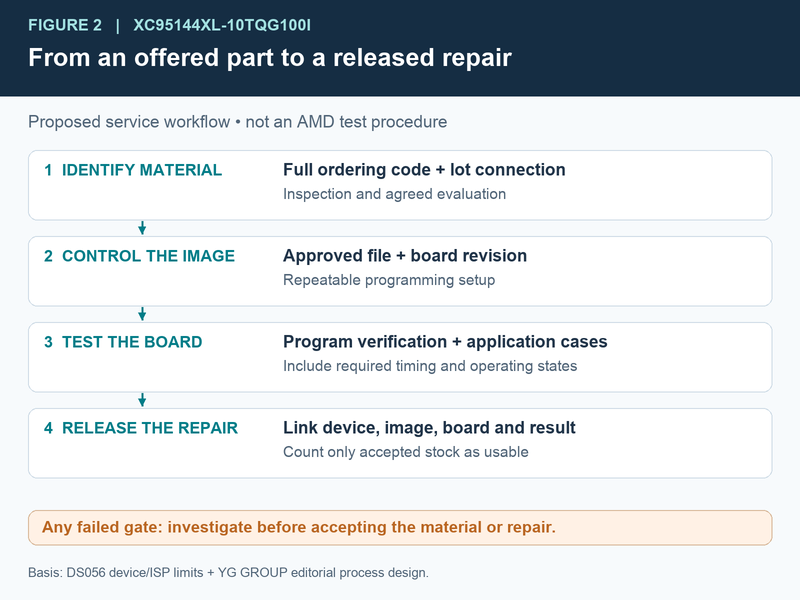
Temperature testing should follow the application's justified needs and the approved test plan. The industrial operating range is relevant to an outdoor or unconditioned installation, but it does not erase the separate 0°C to +70°C programming warning. Program under the specified programming conditions, then evaluate operation as required. Keeping those operations distinct prevents an industrial suffix from being used to justify an unsupported programming procedure.
Record failures with enough context to guide the next action. A failure to identify the JTAG chain may point to power, connections or fixture settings. A programmed device that fails one board mode may point to configuration selection or an assembly problem. Neither observation alone proves a defective lot. Equally, a successful rework attempt should not erase the initial failure from the record. Preserve the investigation so later repairs benefit from it.
Start with the installed equipment that will remain in service, not with the quantity that happens to be offered. Record the support period, the expected retirement schedule, actual relevant repair history, usable stock already held, and any assemblies that can be repaired or replaced without consuming this device. Deduct stock only when its configuration and acceptance status make it usable for the intended task.
A simple planning calculation can make the assumptions visible. Suppose an illustrative fleet has 800 units, an assumed CPLD-consuming repair rate of 1% per year, and three years of service remaining. A constant-fleet estimate gives 24 devices. Add six devices for engineering and repair-process needs, then subtract ten verified usable spares: the calculated shortfall is 20 devices. These numbers are a worked planning example, not a measured failure rate or a recommended purchase quantity.
The sensitivity is more important than the single answer. If the same assumed repair rate were 2%, estimated repair consumption would become 48 devices and the shortfall 44. If half the fleet retires early, a constant-fleet calculation may overstate consumption. If one board uses two devices, a device-per-repair assumption may understate it. Write those assumptions beside the calculation so a reviewer can change them without reconstructing the whole model.
Do not add a percentage reserve and call it a statistical confidence level. A confidence claim requires a model and supporting data. For a sparse repair history, scenario planning may be more honest: show what happens under lower, expected and higher consumption, then decide how much exposure the business can accept. Include losses from qualification, assembly and troubleshooting separately when evidence supports them, so they are not hidden inside a supposed field-failure rate.
The purchase also needs an exit condition. Decide when declining usable stock, a programming-process failure, or a change in the supported fleet will trigger a redesign or replacement-assembly project. Without such a trigger, a spare reserve can become a reason to postpone engineering until the last usable device has been consumed. The reserve should buy time for a defined service strategy, not conceal the absence of one.
A bare CPLD reserve and a tested replacement-board reserve provide different kinds of coverage. Components can be efficient when the service center has the equipment and skills to remove, install, program and test the device. Complete assemblies can shorten a field repair when the installation cannot support that work. Neither strategy is automatically cheaper once the whole repair path is included.
For the component route, account for the fixture, retained programming environment, technician time, rework yield and the possibility that the original board has another fault. For the assembly route, account for storage, configuration management and the other components that must remain serviceable. A spare board containing the right CPLD but the wrong interface revision can be just as unusable as a loose device with the wrong suffix.
Measure the reserve in repairs it can support within the required turnaround. A shelf count alone misses that constraint. If only one facility can program the CPLD, include transport and scheduling in that turnaround. If field teams exchange assemblies, define how returned boards are inspected and restored to the repair pool. These are operational choices, but they determine whether the electronic component provides any useful coverage.
For a finite fleet, a mixed reserve may be worth evaluating: immediately deployable boards for urgent repairs and controlled components for replenishing the board pool. Keep both allocations visible in the demand calculation so the same device requirement is not counted twice.
Related devices are useful for discussing logic scale and migration effort. They are not a shopping list of interchangeable spares. The four below have different underlying device identities, and all appear within the discontinued families covered by XCN23009. Their relevance is historical comparison and the evaluation of an existing legacy design, not a claim that moving to one of them solves lifecycle exposure.
Table 5. Four related devices and the gap that prevents automatic substitution
| Related ordering code | Verified device/package distinction | Value of the comparison | Gap to resolve |
|---|---|---|---|
| XC9536XL-10VQG44I | 36 macrocells; lead-free 44-pin VQFP with 34 user I/O | Shows the resource and pin reduction in a much smaller family member | Logic fit, new pin map and board redesign; DS058 pages 1 and 8 |
| XC9572XL-10TQG100I | 72 macrocells; lead-free 100-pin TQFP with 72 user I/O | Exposes the risk of equating the same pin count with the same resources | Fewer resources and different usable-pin allocation; DS057 pages 1, 7 and 9 |
| XC95288XL-10TQG144I | 288 macrocells; lead-free 144-pin TQFP with 117 user I/O | Shows the board and resource implications of moving upward in density | Larger package, pin mapping, power and timing review; DS055 pages 1 and 13 |
| XCR3128XL-10VQG100I | 128 macrocells; lead-free 100-pin VQFP with 84 user I/O | Adds an XPLA3 architecture comparison at a broadly similar logic scale | Different architecture, package/pins and configuration flow; DS016 pages 1, 8 and 10 |
Sources: Xilinx DS058 v1.9, manufacturer-authored mirror, DS057 v2.0, DS055 v2.1, and DS016 v2.6. Relationships are comparisons, not verified replacements.
The XC9572XL comparison is particularly instructive. Both order codes can end in -10TQG100I, yet the smaller device has half as many macrocells and fewer exposed user I/O. A common package description therefore cannot approve the change. First inspect the implemented logic and net assignments; then determine whether a new fit and board changes are feasible. The similarity is a reason to investigate carefully, not a reason to skip the investigation.
More capacity is not automatically a simpler repair either. Moving to the 144-pin XC95288XL changes the physical board problem. Moving to XPLA3 changes the architecture problem. If a redesign is already necessary, evaluate a supportable long-term platform against the system requirements rather than choosing another discontinued part solely because its name or macrocell count feels familiar.
The case for retaining XC95144XL-10TQG100I is strongest when the approved logic, board interfaces and repair process are already under control. That can make qualified exact spares a practical bridge for a finite installed base. The reason weakens when the design assets are missing, the offered material cannot be tied to acceptable evidence, or the service commitment has grown beyond a credible reserve.
Before placing the main order, put the complete ordering identity, material evidence, configuration release, sample results, acceptance terms and demand assumptions into the same decision. The buyer should be able to explain what is being purchased; engineering should be able to explain how it becomes a working board; the service owner should be able to explain how long that plan needs to last.
Approve the quantity only when the material and the repair process both have an evidence-backed route to acceptance. That turns a difficult discontinued-part purchase into a controlled service decision. It also leaves a clear record for the next person who must repair the equipment, perhaps long after the original design team has moved on.