
Jolin Zeng



6 views

| Picture | Part Number | Manufacturer | Stock | Action |
|---|---|---|---|---|
 | MCIMX6S5EVM10AC | NXP | 7,850 | |
 | MCIMX6S5EVM10ACR | NXP | 4,910 | |
| MCIMX6S5EVM10AB | NXP | 9,240 | |
| MCIMX6S5EVM10ABR | NXP | 3,030 |
No. The published row is family-level context subject to program terms. Confirm the exact order code, applicable notices and order acceptance separately. A dated supplier commitment is still needed for a production schedule.
Yes. The reviewed datasheet maps final C to revision 1.2 with mask 2N81E and revision 1.3 with mask 3N81E. Capture mask information and apply the project's revision acceptance rules; do not infer it solely from AC. IMX6SDLCEC, Figure 1, p. 5.
It is a related part with a documented silicon-revision difference. Approval depends on the specific board, software, errata assessment and qualification record. This article does not grant replacement approval or claim that an AB offer has a better supply position.
Keep usable, qualified stock separate from quarantined stock and prospective purchases. Count a future receipt against a build only when its identity, qualification, delivery and release timing support that use. A scenario column may show possible supply, but it should not conceal a gap in firm coverage.
By Jolin Zeng
MCIMX6S5EVM10AC is an NXP i.MX 6Solo processor whose complete order code identifies its feature set, package, temperature grade, fuse option, and silicon-revision group. Planning production around it requires more than a family lifecycle label. This guide connects the exact device identity to supplier evidence, qualified hardware and software, and time-phased material coverage, so procurement can distinguish a long-term product program from the parts actually available for a scheduled build.
For an established embedded product, the practical supply question is precise: can the approved processor, in an acceptable configuration and condition, arrive before manufacturing needs it? A processor family can remain supported while a particular quotation is incomplete, a lot needs qualification, or another essential BOM item is unavailable. These are separate problems with separate evidence.
On September 20, 2026, NXP's i.MX 6Solo family page identified the family as Active and linked MCIMX6S5EVM10AC among the supported consumer-datasheet parts. NXP also maintains an exact AC catalog listing. A catalog identity and a family Active label do not establish delivery terms for the complete suffix. Confirm current orderability and delivery against a dated quotation.
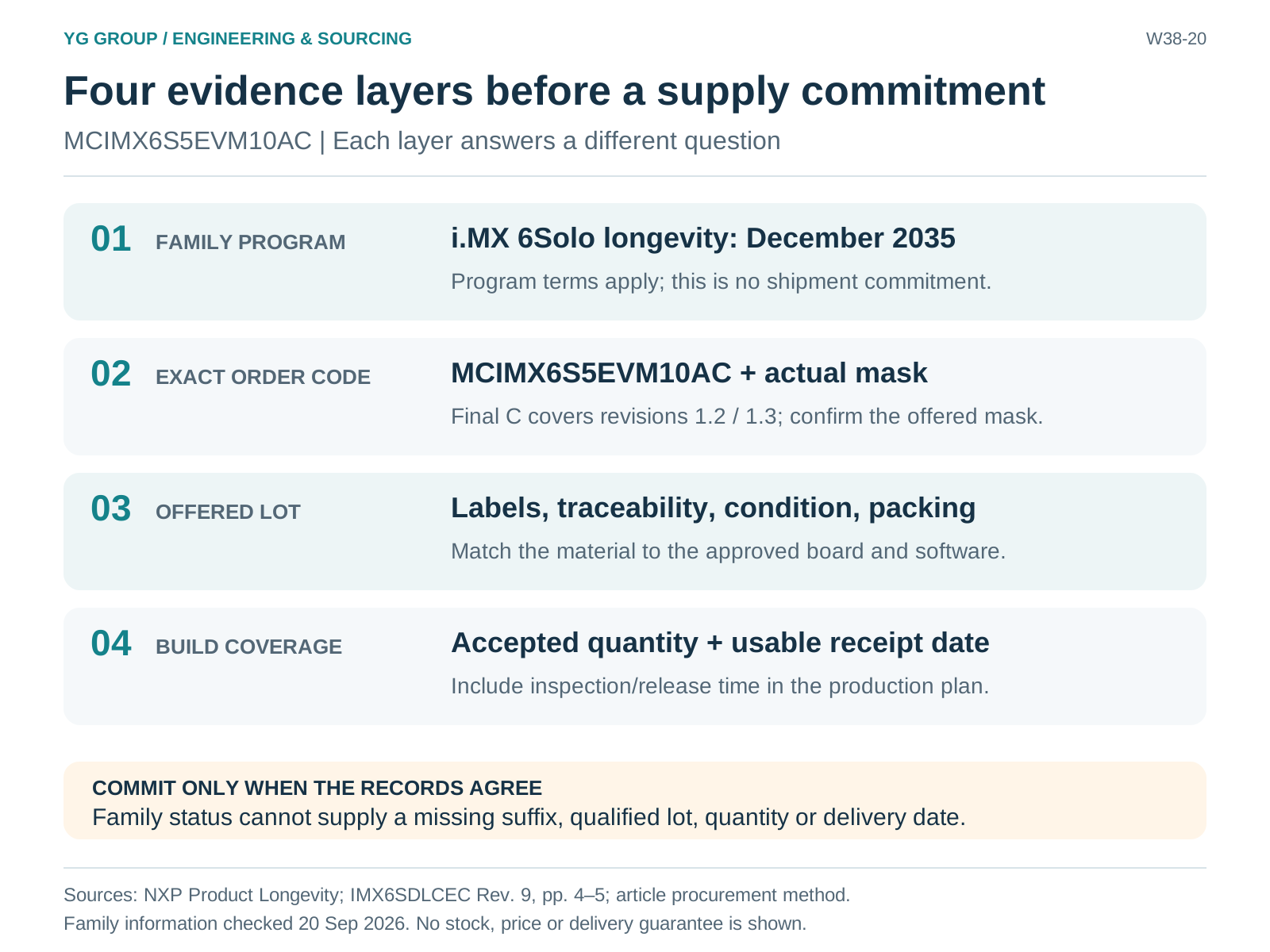
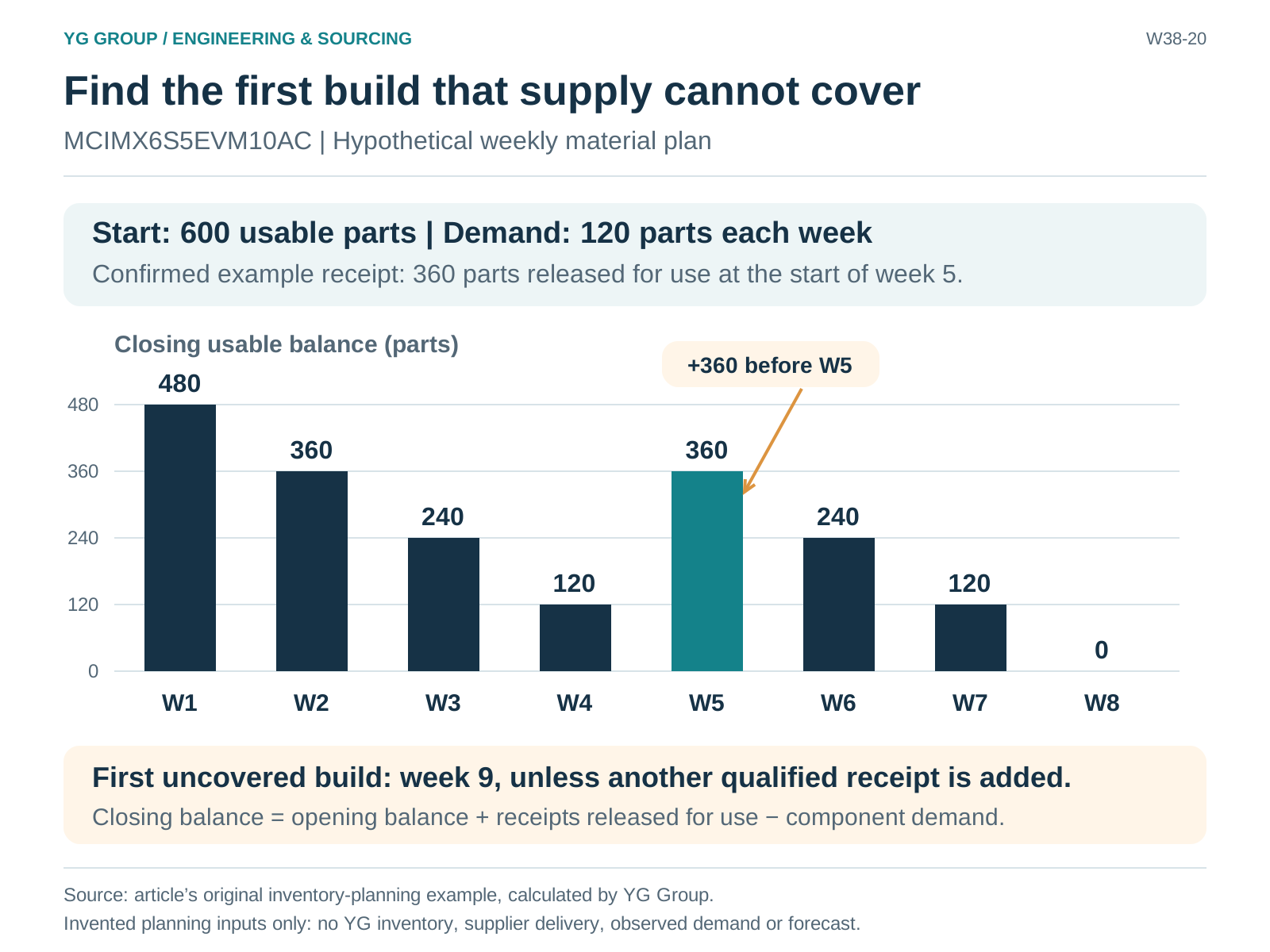
**Figure 1. Four evidence layers before a supply commitment.** YG Group synthesis of NXP family-program and ordering evidence plus the article’s procurement method. The December 2035 family longevity date is subject to program terms and is not a shipment commitment for the exact suffix or offered lot. Sources: [supporting source 1](https://www.nxp.com/products/nxp-product-information/nxp-product-programs/product-longevity:PRDCT_LONGEVITY_HM); [supporting source 2](https://www.nxp.com/docs/en/data-sheet/IMX6SDLCEC.pdf). **Figure 2. Find the first build that supply cannot cover.** Original hypothetical planning example calculated by YG Group. Closing balances are 480, 360, 240, 120, 360, 240, 120 and 0 parts. Under the stated demand and receipt assumptions, week 9 is the first uncovered build. These are not actual inventory, supplier commitments or demand forecasts.The current NXP Product Longevity table lists i.MX 6Solo through December 2035. Its terms permit manufacturing-site changes and may require migration to a compatible product; reaching the listed date does not automatically discontinue production. That is useful planning context, with defined conditions. It is not a dated shipment commitment for MCIMX6S5EVM10AC.
Maintain four distinct records: the family program, the complete orderable part, the offered lot, and the accepted delivery schedule. A green status in the first record cannot fill missing fields in the other three. Conversely, an incomplete quote does not prove that the manufacturer has discontinued the device.
NXP’s consumer datasheet, IMX6SDLCEC Revision 9, explicitly lists MCIMX6S5EVM10AC in Table 1. Its ordering diagram explains why dropping a character changes the review. The selected device is a single-core i.MX 6Solo with a 32-bit DDR interface, VPU, GPU, and MLB; this feature selection does not include EPDC. The broader document also describes DualLite and other feature selections. Those capabilities must not be inherited indiscriminately. NXP datasheet, Table 1 and Figure 1, pp. 3–5.
Table 1. Identity record for MCIMX6S5EVM10AC
| Field | Meaning established by the datasheet | Procurement consequence |
|---|---|---|
| MC | Mass-production qualification prefix | Preserve the full prefix; a sample or special code needs a separate review |
| IMX6S | i.MX 6Solo, one Arm Cortex-A9 core, 32-bit DDR interface | Do not substitute a DualLite identity or assume its wider memory bus |
| 5 | Consumer feature selection with VPU, GPU and MLB, without EPDC | Match the functions used by the released product |
| E | Extended-commercial junction-temperature grade, −20°C to +105°C | Do not translate it into a −40°C industrial grade or an ambient rating |
| VM | MAPBGA, 21 × 21 mm, 0.8 mm pitch | Compare the package drawing and assembly footprint |
| 10 | 1 GHz speed grade | With a 24 MHz input clock, required for USB, the datasheet limits maximum SoC speed to 996 MHz |
| A before the final letter | Default fuse setting option | Keep it distinct from the separately coded HDCP-enabled option |
| Final C | Silicon revision 1.2 with mask 2N81E, or revision 1.3 with mask 3N81E | Obtain the actual mask identification; the order code alone does not distinguish these two revisions |
Source: IMX6SDLCEC Rev. 9, pp. 4–5. Compiled by YG Group. Meanings describe the document's ordering scheme, not the condition of an offered shipment.
The package table specifies 624 balls, a 21 × 21 mm body, and 0.8 mm pitch. These are identification checks, not an assembly-process qualification. Confirm the land pattern, board revision, placement orientation, and the shipment's handling information with the assembler. A package name in a quotation is too broad to authorize an engineering change. NXP datasheet, Figure 101 and Table 95, pp. 138–139.
Temperature deserves particular care. The E code describes junction temperature. A device dissipating power in an enclosure will not necessarily have the same junction and ambient temperatures. Procurement should carry the approved grade from the engineering BOM; it should not downgrade or upgrade a grade using a loose description such as “industrial application.” Engineering must assess the actual thermal environment before approving a changed order code.
MCIMX6S5EVM10AB is a useful comparison because the same datasheet lists it with the same core, feature selection, speed grade, temperature grade, and package. However, the final B denotes silicon revision 1.1. AC belongs to the later revision group described in Table 1. Shared headline specifications do not establish that a frozen production image behaves identically on both.
NXP's EB804 silicon-revision comparison, Revision 5, documents ROM changes between revisions 1.1 and 1.2 and identifies affected historical U-Boot plug-in and secure-boot paths. It states that no software changes are required for the 1.2-to-1.3 migration. These statements have a specific historical software context; they do not approve every customer image or establish reverse compatibility with revision 1.1. EB804, pp. 2–4.
Build the review around the actual software and hardware release. Record the boot medium, bootloader version, board-specific initialization, security configuration, enabled peripherals, and the silicon revisions previously qualified. Then compare the offered revision against the applicable errata and migration documentation. Preserve existing workaround decisions until an engineer has checked whether their conditions still apply.
An effective acceptance record includes two forms of identity. The package and lot records establish what was delivered. A controlled diagnostic on the assembled board establishes what the running system reports. Resolve any disagreement before using the lot in customer production. Do not discard a mismatch merely because the board reaches a login prompt: a limited boot demonstration leaves storage, reset recovery, power transitions, and enabled interfaces untested.
For purchasing, the decision can be concise: AB is a related revision candidate, not a preapproved drop-in replacement for AC. If AB is already on the project's approved vendor list, preserve the exact approval conditions. If it is not, book the qualification work before counting an AB offer as coverage for an AC demand line.
The processor's remaining supply horizon is only one constraint on the finished product. An unavailable or unqualified memory, power-management component, boot device, or external interface can stop a build that has enough processors. This is a BOM dependency, not a claim that any particular companion part is currently scarce.
For MCIMX6S5EVM10AC, the memory boundary is especially useful. The datasheet's Solo configuration table describes 16- or 32-bit DDR3, DDR3L, and LPDDR2 arrangements with a 400 MHz maximum memory clock. DualLite entries elsewhere in the document include configurations that do not belong to Solo. A replacement-memory review must begin with the installed topology, voltage, organization, timing, and initialization settings. A matching density or a higher advertised speed is not sufficient. NXP datasheet, Table 44, p. 63.
The power and boot dependencies are similarly concrete. NXP specifies a power-up relationship for VDD_SNVS_IN and requires external reset to remain asserted until the relevant supplies are stable. Its boot tables distinguish interfaces and describe how straps interact with fuse selection. A replacement PMIC or storage device can therefore affect a product even while the processor MPN stays fixed. NXP datasheet, Section 4.2, pp. 33–34; Section 5, pp. 134–136.
Table 2. Companion-BOM review before accepting a longer production schedule
| Dependency | What the released design must identify | What a supply-driven change must demonstrate |
|---|---|---|
| DRAM | Exact parts, topology, supply, controller settings and initialization data | Stable operation across the product's qualified conditions with the proposed memory |
| Boot storage | Exact part, physical interface, boot mode, programmed image and manufacturing procedure | Boot, update and recovery behavior on the actual board and silicon revision |
| Power and reset | Approved regulator/PMIC parts, sequencing and reset circuit | Compliance with the processor's sequencing and rail requirements, including power transitions |
| External interfaces | Actual PHYs, transceivers, clocks and I/O supply domains | Electrical and firmware compatibility with each changed part |
| Assembly | Board and stencil revisions, footprint, handling and inspection process | A controlled assembly release for the delivered package and its actual condition |
| Software baseline | Build inputs, bootloader, OS, drivers, configuration and maintenance owner | Reproducible builds and a defined qualification scope for each change |
Table 2 is a YG Group engineering and procurement workflow derived from the processor's documented dependencies. It is not a list of tested replacements.
Keep the companion review at exact-part level. “DDR3 available” says little about an approved memory part's temperature range and timing. “PMIC compatible” must resolve into rails, sequence and control behavior. Broad labels are useful for identifying the responsible engineer; they are insufficient for releasing a substitute to production.
A usable quotation should answer what is being offered, how it will be identified, when it can ship, and which conditions apply. Separate supplier statements from independently checked facts. A quantity shown in a marketplace listing is not the same evidence as identified material reserved against an accepted order.
For this processor, request the complete manufacturer MPN; quantity by shipment date; packing form and original-label information; available lot, date-code and mask identification; traceability documents; handling and storage condition; and the agreed acceptance and discrepancy process. Record the response date and quote validity. Where a seller cannot establish a field, leave it explicitly unresolved rather than silently filling it from an older purchase.
The significance of a missing field depends on the decision. Missing mask information prevents a revision-specific qualification judgment. Missing packing information prevents the assembler from planning handling confidently. An unconfirmed ship date cannot be used as a firm production receipt. The procurement record should identify the owner and closure date for each gap.
A label photograph is useful evidence for identity review, but it does not alone establish authenticity, condition, or performance. Match the documents to the actual shipment and apply the organization's risk-based receiving process. If an offered lot requires additional inspection or sample qualification, include the associated time in the material plan. Material on the dock is not yet material released to the line.
Keep these commercial records separate from public editorial claims. This article provides no current YG Group stock quantity, price, lead time, or manufacturer authorization claim for MCIMX6S5EVM10AC. Those facts would require their own current evidence and quotation.
A single “weeks of stock” number is convenient, but it can conceal a gap before the next delivery. A better worksheet places demand, released inventory and confirmed receipts on the same calendar. Quarantined stock, unqualified revisions and unconfirmed offers should remain separate from the firm coverage column.
For week t, calculate:
Closing usable balance(t) = opening usable balance(t) + receipts released for use(t) − planned component demand(t).
Carry that closing balance into the next week. If a proposed receipt arrives late in the week, check it against the actual build date rather than assuming it was available at the week's start. Include inspection and material-release time in the receipt date. The calculation is a planning model; its reliability depends on the inputs.
Consider an illustrative case with one processor per board, 600 usable processors at the start, and a flat demand of 120 processors each week. An additional 360 devices are confirmed to be released for use at the start of week 5. The resulting balances are 480, 360, 240, 120, 360, 240, 120, and zero after weeks 1 through 8. Week 9 is the first uncovered build unless another qualified receipt is added.
These figures are invented planning inputs for arithmetic only. They are not YG inventory, a supplier quote, observed market demand, or a forecast for the part. Production loss allowances, service reserves and variable demand would need explicit inputs in a real worksheet.
Now add a possible revision change. Suppose internal planning estimates eight weeks to qualify an alternate revision and two weeks after that to receive and release its material. If work starts at the beginning of week 1, that path cannot cover the example's week-9 build. An inexpensive alternate offer may therefore be commercially irrelevant to the immediate gap. The team must examine a qualified bridge receipt, a revised build schedule, an earlier qualification start, or another approved path.
The point is to compare complete timelines. Purchasing lead time without inspection time is incomplete. Qualification time without test capacity and sample availability is incomplete. A longevity year does not appear in the weekly balance because it supplies no quantity or receipt date.
NXP distinguishes Active, NRND, EOL and NLM: Active permits production orders; NRND discourages new designs without itself announcing discontinuance; EOL introduces final-order and final-delivery dates; NLM means new orders and manufacture have ended. Use those definitions when interpreting a notice, then verify which exact parts it covers. NXP Product Lifecycle.
Table 3. Evidence-to-action map for an established MCIMX6S5EVM10AC design
| Evidence received | Appropriate next action | What the evidence does not settle |
|---|---|---|
| Family remains in the longevity program | Retain the dated program record and continue exact-part monitoring | Availability of a particular suffix, mask or lot |
| Exact-part quotation with dated deliveries | Enter only accepted, qualified receipts into the material plan | Whether an unqualified change is safe for the released design |
| Product-change notice affecting the exact part | Identify affected lots, process changes, qualification evidence and internal review tasks | Automatic interchangeability in every application |
| Discontinuance notice affecting the exact part | Use the stated final dates to compare bridge-buy and migration schedules | The amount the business should buy without a demand and service model |
| Alternate revision or companion component offered | Compare qualification completion with the first uncovered build | Permission to substitute merely because the package or family matches |
Table 3 is an editorial operating method. It does not state that MCIMX6S5EVM10AC is currently subject to any of the notices described.
Assign responsibility for checking these records. Procurement owns supplier responses and delivery changes; engineering owns revision and BOM compatibility; manufacturing owns assembly and release readiness; the product owner owns demand and service assumptions. One person can coordinate the file, but each decision needs the appropriate evidence and accountable owner.
Software maintenance also has its own horizon. In an August 7, 2026 article, NXP described separate Mainstream and LTS paths for i.MX Linux maintenance. That strategy is not a support entitlement for every existing i.MX 6Solo image. Confirm the applicable device, software stream, terms and support scope for the actual product. NXP, A Smarter Linux Path for Long-Life i.MX Products.
A practical release packet combines the full MCIMX6S5EVM10AC identity, accepted silicon-revision scope, current notices, a dated supplier response, companion-BOM readiness, and a time-phased material plan. It should also state what remains open and whether those gaps affect the next build.
This makes the decision reviewable. The team can continue an established design, qualify a change, secure bridge material, or revise a schedule for a concrete reason. The lifecycle label remains useful, while the production commitment rests on evidence that identifies real material and the date it can be used.