
Kelsey Lee



3 views

No. Confirm the exact part number, package, host-interface requirements, boot behavior and partition configuration. Capacity alone leaves important integration and production decisions unanswered.
Only after the engineering team determines that the conditions answer the application’s requirement. The table’s host setup and transfer conditions matter. Define the actual workload and acceptance procedure rather than copying an isolated throughput figure.
It records useful electronic identification, but it does not establish the complete source or handling history. Combine the readout with traceability records, physical inspection and agreed testing.
Start with an approved read-only procedure. Any programming requires an explicit engineering process that accounts for persistent and one-time settings and records what changed.
A dated link between approved demand, the technical configuration, the supply commitment and the lot’s acceptance status. That record lets the team revise the decision when demand, the board design or delivery evidence changes.
By Kelsey Lee | Draft revised 21 September 2026
KLMBG2JETD-B041 is Samsung’s 32 GB eMMC device in a 153-ball FBGA package. Procuring it requires more than matching capacity: the buyer needs an agreed device identity, an approved host configuration and evidence about the offered lot. This guide connects Samsung’s documented device features to practical checks for quotations, incoming inspection, production programming and stocking, while keeping historical specifications separate from current supply commitments. Samsung datasheet, product list and introduction, p. 4.
Samsung’s product list identifies KLMBG2JETD-B041 as the 32 GB member of its KLMxGxJETD-B041 eMMC family. The device combines NAND flash and an embedded controller, and the document describes compatibility with the eMMC 5.1 specification. The controller manages the underlying flash, including wear leveling, bad-block management and error correction. Those functions simplify the host interface; they do not remove the need to qualify the memory in the intended system. Samsung datasheet, introduction and key features, p. 4.
**Figure 1. Four records for an eMMC stocking decision.** Proposed procurement-evidence framework for KLMBG2JETD-B041. The four records answer separate questions: document identity, applicability to a target build, a dated supply commitment and acceptance of the actual lot. The Samsung document establishes part identity, while the framework makes no current-availability or lot-acceptance claim. Source: [Samsung Rev. 1.0 datasheet](https://datasheet.lcsc.com/datasheet/pdf/8cca530d6d5054b226dcd9a69d076028.pdf?productCode=C2803245). **Figure 2. Keep electronic identity tied to the sample.** Proposed read-only electronic-identity record for KLMBG2JETD-B041. Keep raw data, tool version, sample identifier and packaging linked. Register descriptions support interpretation, but a readout alone does not prove authenticity, complete handling history or lot acceptance. No sample was read for this figure, and no persistent or one-time configuration write is part of the proposed capture. Source: [Samsung Rev. 1.0 datasheet](https://datasheet.lcsc.com/datasheet/pdf/8cca530d6d5054b226dcd9a69d076028.pdf?productCode=C2803245).Use the complete base part number, KLMBG2JETD-B041, consistently in the approved BOM, quotation request and inspection record. Attach the drawing or specification revision that engineering uses. A description such as “Samsung 32 GB eMMC” leaves too many decisions unresolved, including package compatibility, supported interface modes and the configuration expected by the production image.
Identify the destination build as well. A qualified component for one board revision is not automatically an approved component for another board with different power sequencing, boot software or routing. Give purchasing a controlled configuration to buy against: board revision, bootloader and firmware release, programming procedure, required delivery form and agreed acceptance criteria.
A dated datasheet establishes a technical reference. It does not establish that a supplier holds the quoted quantity today, that Samsung still manufactures that item, or that an offered lot has passed incoming inspection. These questions belong in separate records.
An effective procurement review separates the technical identity of a component from the commercial and physical evidence for a particular delivery. The following framework is a proposed purchasing control, not a manufacturer certification scheme.
| Record | What it should establish | What it cannot replace |
|---|---|---|
| Device identity | Manufacturer, full base part number, applicable specification and package reference | Verification of the particular delivered lot |
| Technical applicability | Approval for the intended board, software, interface and memory configuration | A dated supply commitment |
| Supply commitment | Quoted item, quantity, price validity, delivery terms and agreed documentation | Evidence that every delivered device passes acceptance |
| Lot acceptance | Traceability records, inspection findings and the agreed sample or production-test results | Approval for a different board or configuration |
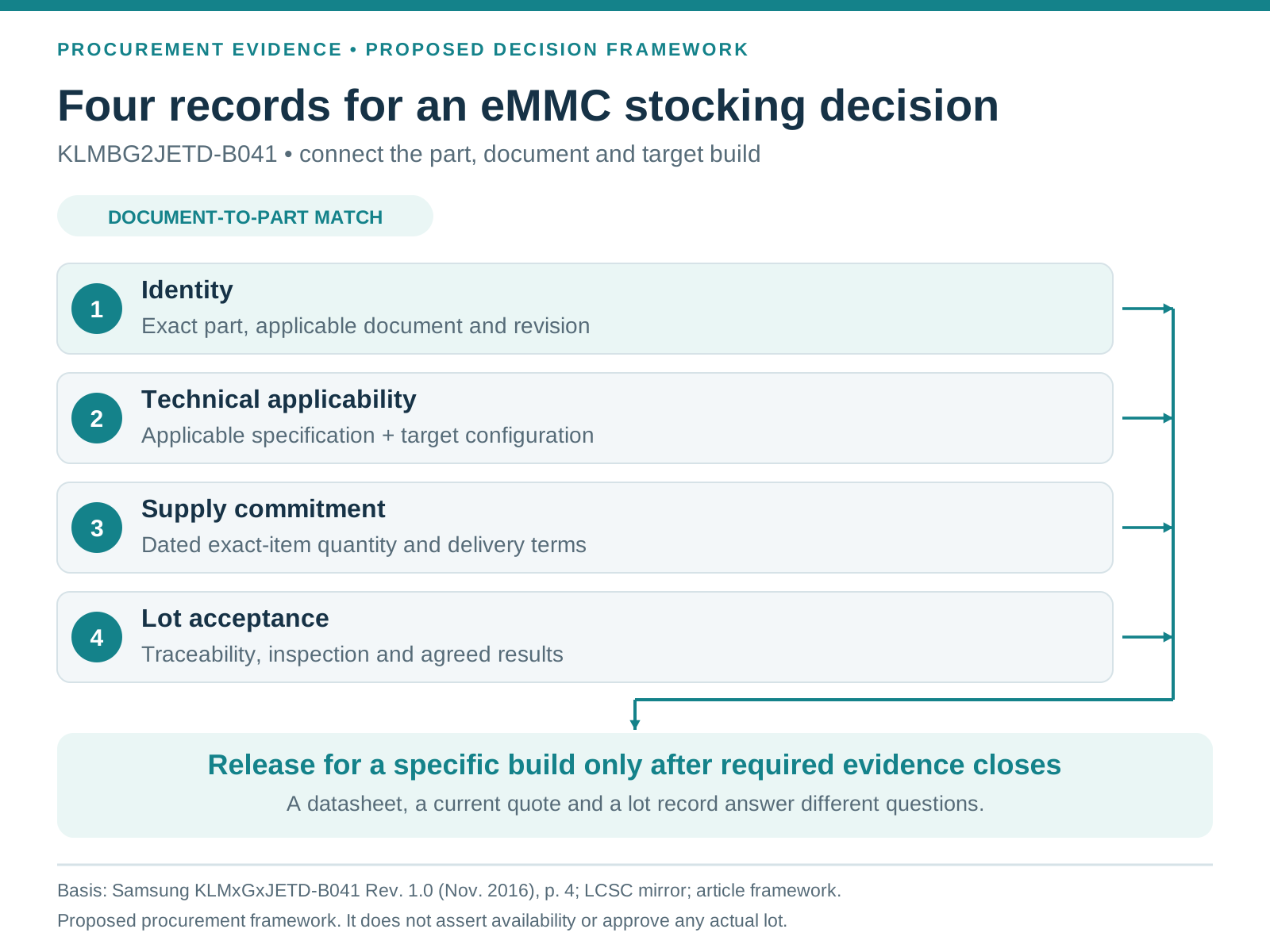
For example, a quotation can meet the required quantity and delivery date while leaving the production-programming state unspecified. Conversely, an engineering sample can work correctly without demonstrating that the supplier can deliver a consistent production lot. Resolve the relevant gap before using either record to justify a larger purchase.
The “32 GB” product designation is a starting point for capacity planning. Samsung describes a user data area, two boot partitions and a replay-protected memory block, or RPMB. The user area can also be partitioned, and enhanced-area configuration changes the capacity available for other uses. The documented enhanced mode consumes additional underlying capacity; an application cannot assume that every partition arrangement preserves the same usable storage. Samsung datasheet, partition management and user-density sections, §§6.1.1–6.1.3.
Before ordering a programmed or previously configured device, ask which partition arrangement and boot settings will be delivered. Compare that answer with the production image, update scheme and recovery requirements. A board that expects a boot image in a particular partition needs more than a matching total-capacity label.
Write the expected state into the programming specification. Include which settings the production process may change, which settings it must preserve, and how it verifies the result. Samsung’s register descriptions distinguish read-only, writable, persistent and one-time programmable fields. A blanket instruction to restore defaults is therefore an inadequate receiving or rework procedure. Samsung datasheet, register access definitions and Extended CSD, pp. 16–20.
If the supplier cannot describe the delivered configuration, treat the issue as an engineering question before releasing the lot to programming. Do not assume that a generic programming utility can reverse every earlier configuration choice.
The family datasheet documents HS400 support. That capability is relevant when reviewing the host controller, board interface and software, but it is not a throughput guarantee for an assembled product. Samsung gives explicit conditions for its performance table, including an eight-bit bus, HS400 operation, a specified transfer size, exclusion of file-system overhead and measurement on Samsung’s internal board. Samsung datasheet, HS400 and performance sections, §§4.0 and 6.1.5.
A purchasing acceptance limit should answer the product’s requirement under a reproducible workload. For a logging product, that might mean sustaining the required incoming data while the application performs its normal housekeeping. For a boot device, startup and recovery behavior may matter more than a large sequential transfer. These are proposed application tests, not reported results for a YG Group sample.
Record the host board, software versions, negotiated interface mode, request sizes, access pattern, storage occupancy, test duration and temperature conditions. Retain error and recovery observations alongside throughput measurements. An average transfer rate can hide a timeout that prevents the application from meeting its real-time requirement.
Agree who approves the test and what happens if it fails. A failed system-level test does not identify its cause by itself: board conditions, configuration and software must be investigated as well as the component. The purchase agreement and engineering procedure should provide a clear route for that investigation.
Samsung’s CID register describes manufacturer identification, product name, product revision, serial number and manufacturing date. Its product-name table explicitly associates a CID product-name entry with KLMBG2JETD-B041. These fields provide useful information to retain during an approved sample or incoming inspection. Samsung datasheet, CID and product-name tables, p. 15.
Preserve the raw readout, tool version and sample identifier, and link them to the packaging and delivery records. A screenshot showing only a recognized product name discards information that may be needed when comparing samples or investigating a later failure. Retain the interpretation separately from the raw bytes so that another engineer can review the same evidence.

Begin with read-only inspection. Samsung’s Extended CSD defines device properties and operating modes, with different access rules for individual fields. An inspection tool should not silently change boot configuration, partitioning, protection or other persistent settings. Engineering should approve the allowed operations before any programming step. Samsung datasheet, CSD and Extended CSD access definitions, pp. 16–20.
Electronic identification is one piece of a traceability record. It does not replace source documentation, physical inspection or the agreed functional acceptance test. Likewise, a register value should not be converted into a remaining-life guarantee without the applicable interpretation and supporting evidence.
Give each received lot a record that purchasing, quality and engineering can follow. Useful fields include the supplier’s quoted item, purchase-order reference, delivery quantity, package and lot markings, supplied documents, inspection date, sample selection, tools used and disposition. These are recommended record fields, not a claim that a particular lot already has complete traceability.
Record discrepancies before material moves into production. If the delivery documentation and physical markings differ, preserve both observations and obtain a documented resolution. If testing changes a device’s configuration, retain the before-and-after state and the approved procedure. Mixing that sample back into untouched material without recording the change makes later investigation harder.
Assembly readiness also needs its own evidence. Request packaging, storage and handling documentation for the actual delivery form, and have the responsible manufacturing team determine whether the received lot is ready for assembly under its approved process. This is a proposed receiving control; no reflow profile or assembly qualification is established by this article.
Stocking quantity should follow the build plan and the evidence available for replenishment. Start with the quantity required by approved builds, the purchasing team’s current delivery commitments, material already accepted and the time needed for inspection and programming. Keep assumptions dated so that another buyer can understand why the quantity was chosen.
A larger purchase may reduce the number of replenishment events, but it also concentrates exposure to one lot, one configuration or a later design change. A smaller initial release can make sense when a new source or programming arrangement still needs qualification. That is a planning tradeoff to document, not a universal recommendation to buy more or less.
Avoid using a historical document date as a proxy for current lifecycle status. Request applicable lifecycle or change notices separately when the decision depends on them. Similarly, a supplier’s quantity indication should be tied to a dated, item-specific commitment; a broad catalogue listing does not establish a delivery schedule.
For a sourcing discussion with YG Group, provide KLMBG2JETD-B041, required quantity, destination build, acceptable delivery window and the documentation or testing needed before release. Evaluate the resulting quotation and lot evidence against those requirements. This article makes no claim about current stock, price, lead time or authorization status.